Pages

Showing posts with label BEST OF 2013. Show all posts

Friday, February 20, 2015

Ansel Adams Birthday

Ansel Adams The Tetons and the Snake River (1942) Grand Teton National Park, Wyoming. National Archives and Records Administration, Records of the National Park Service. (79-AAG-1)
There is one name that every one knows and associates with photography: Ansel Adams.
Born Ansel Easton Adams on February 20, 1902 in San Francisco, California, Adams has inspired generations of aspiring photographers.  Here is his story as told by Wikipedia.

Ansel Adams photo by J. Malcolm Greany 

Ansel Easton Adams (February 20, 1902 – April 22, 1984) was an American photographer and environmentalist, best known for his black-and-white photographs of the American West, especially in Yosemite National Park.
With Fred Archer, Adams developed the Zone System as a way to determine proper exposure and adjust the contrast of the final print. The resulting clarity and depth characterized his photographs and the work of those to whom he taught the system. Adams primarily used large-format cameras despite their size, weight, setup time, and film cost, because their high resolution helped ensure sharpness in his images.
Adams founded the Group f/64 along with fellow photographers Willard Van Dyke andEdward Weston. Adams's photographs are reproduced on calendars, posters, and in books, making his photographs widely distributed.
Childhood

Adams was born in the Western Addition of San Francisco, California, to distinctly upper-class parents Charles Hitchcock Adams and Olive Bray Adams. He was an only child and was named after his uncle Ansel Easton. His mother's family came from Baltimore and his maternal grandfather had a successful freight-hauling business, but squandered his wealth in failed mining and real estate ventures in Nevada.[1] The Adams family came from New England, having migrated from the north of Ireland in the early 18th century. His grandfather founded and built a prosperous lumber business, which his father later ran, though his father's natural talents lay more with sciences than with business. Later in life, Adams would condemn that very same industry for cutting down many of the great redwood forests.[2]
In 1903, his family moved two miles west to a new home near the Seacliff neighborhood, just south of the Presidio Army Base.[3] The home had a "splendid view" of the Golden Gate and the Marin Headlands.[4] San Francisco was devastated by the April 18, 1906 San Francisco earthquake. Uninjured in the initial shaking, the four-year-old Ansel Adams was tossed face-first into a garden wall during an aftershock three hours later, breaking his nose. Among his earliest memories was watching the smoke from the ensuing fire that destroyed much of the city a few miles to the east. Although a doctor recommended that his nose be re-set once he reached maturity,[5] this was never done; as a result, Adams's nose remained crooked for his entire life.[6]
Adams was a hyperactive child and prone to frequent sickness and hypochondria. He had few friends, but his family home and surroundings on the heights facing the Golden Gate provided ample childhood activities. Although he had no patience for games or sports, the curious child took to nature at an early age, collecting bugs and exploring Lobos Creek all the way to Baker Beach and the sea cliffs leading to Lands End,[4] [7] "San Francisco's wildest and rockiest coast, a place strewn with shipwrecks and rife with landslides."[8]
His father bought a three-inch telescope and they enthusiastically shared the hobby of amateur astronomy, visiting the Lick Observatory on Mount Hamilton together. His father went on to serve as the paid secretary-treasurer of the Astronomical Society of the Pacific from 1925 to 1950.[9]
After the death of Ansel's grandfather and the aftermath of the Panic of 1907, his father's business suffered great financial losses. By 1912, the family's standard of living had dropped sharply.[10] After young Ansel was dismissed from several private schools for his restlessness and inattentiveness, his father decided to pull him out of school in 1915, at the age of 12. Adams was then educated by private tutors, his Aunt Mary, and by his father. His Aunt Mary was a follower of Robert G. Ingersoll, a 19th-century agnostic, abolitionist and women's suffrage advocate. As a result of his aunt's influence, Ingersoll's teachings were important to Ansel's upbringing.[11] During the Panama-Pacific International Exposition in 1915, his father insisted that, as part of his education, Adams spend part of each day studying the exhibits.[12] After a while, Adams resumed and then completed his formal education by attending the Mrs. Kate M. Wilkins Private School, until he graduated from eighth grade on June 8, 1917. In his later years, he displayed his diploma in the guest bathroom of his home.[13]
His father raised him to follow the ideas of Ralph Waldo Emerson: to live a modest, moral life guided by a social responsibility to man and to nature.[11] Adams had a warm, loving and supportive relationship with his father, but had a distant relationship with his mother, who did not approve of his interest in photography.[14]
[edit]Youth
Adams taught himself piano at age twelve. Music became the main focus of his later youth. Possessing an eidetic memory, he quickly learned to read music and play the piano. Soon he was taking lessons, and the ardent pursuit of music became his substitute for formal schooling. One of his childhood tutors was composer Henry Cowell.[15] For the next dozen years, the piano was Adams's primary occupation and, by 1920, his intended profession. Although he ultimately gave up music for photography, the piano brought substance, discipline, and structure to his frustrating and erratic youth. Moreover, the careful training and exacting craft required of a musician profoundly informed his visual artistry, as well as his influential writings and teachings on photography.
Adams first visited Yosemite National Park in 1916 with his family.[16] He wrote of his first view of the valley: "the splendor of Yosemite burst upon us and it was glorious... One wonder after another descended upon us... There was light everywhere... A new era began for me." His father gave him his first camera, a Kodak Brownie box camera, during that stay and he took his first photographs with his "usual hyperactive enthusiasm".[17] He returned to Yosemite on his own the following year with better cameras and a tripod. In the winter, he learned basic darkroom technique working part-time for a San Francisco photo finisher.[18] Adams avidly read photography magazines, attended camera club meetings, and went to photography and art exhibits. With retired geologist and amateur ornithologist Francis Holman, whom he called "Uncle Frank," he explored the High Sierra, in summer and winter, developing the stamina and skill needed to photograph at high elevation and under difficult weather conditions.[19]


While in Yosemite, he had frequent contact with the Best family, owners of Best's Studio, who allowed him to practice on their old square piano. In 1928, Ansel Adams married Virginia Best in Best's Studio in Yosemite Valley. Virginia inherited the studio from her artist father on his death in 1935, and the Adams continued to operate the studio until 1971. The studio, now known as the Ansel Adams Gallery, remains in the hands of the Adams family.

Close-up of leaves In Glacier National Park (1942)
At age 17, Adams joined the Sierra Club, a group dedicated to preserving the natural world's wonders and resources, and he was hired as the summer caretaker of the Sierra Club visitor center in Yosemite Valley, the LeConte Memorial Lodge from 1920 to 1924.[20] He remained a member throughout his lifetime and served as a director, as did his wife. He was first elected to the Sierra Club's board of directors in 1934, and served on the board for 37 years, until 1971.[6] Adams participated in the club's annual High Trips, and was later responsible for several first ascents in the Sierra Nevada.
During 1919, he contracted the Spanish Flu during the 1918 flu pandemic. Adams fell seriously ill but recovered after several months to resume his outdoor life.

Thursday, January 2, 2014

BEST OF 2013: Video: Opening of the 2013 North Atlantic Blues Festival

Rockland, Maine-The North Atlantic Blues Festival started today on the water front in Rockland.  This is the 20th year for this celebration of the blues.
The North Atlantic Blues Festival is an annual two-day blues music festival featuring national blues performers and considered one of the most prestigious on the East Coast. The festival is held at the Public Landing in Rockland, Maine, overlooking the picturesque Rockland Harbor. Some of the top names in blues music have been featured at this prestigious East Coast festival. In addition to all day live entertainment, the festival has vendors selling a wide array of food, drinks and crafts.


Wednesday, January 1, 2014

BEST OF 2013: Gone Sailing!


Doug Mills
Maritime Editor
RCN America Network

This week the staff of RCN America Network Have gone sailing.  We sail on Sunday, June 29 aboard the historic tall ship Victory Chimes, built in 1900.  This will be my 3rd year sailing on this magnificent ship.  There are 13 of these historic ships that sail these waters off the coast of Maine which carry passengers on a vacation that few will ever forget.  To anchor in a quiet harbor near a small island village that time has forgotten, with the gentle sounds of the waves on the hull, the music drifting across the water from several of the other tall ships that have anchored near by and the smell of dinner cooking on a wood stove.  The cell phone doesn't work and there is no WiFi, so there is time to make a new friend or actually read a book, or maybe just marvel at the beauty of Maine.
The end of the week the whole fleet nearly two dozen ships will gather off Islesboro for The Great Schooner Race, the largest annual gathering of tall ships in North America.  The race will run from Islesboro to the Rockland Breakwater Lighthouse in Rockland Maine.  After the race the boats will all anchor in the head of the harbor at Sharp's Point for an evening of celebration and schooner fun.
By Saturday it is time to head home and start planning for next years cruise.  Yes, you heard right.  One week is never enough and once you sail once you will have to come back again and again.
You may have missed out on The Great Schooner Race this year, but there is a whole summer and fall filled with exciting events you can experience.  If you can get away at all this year...Do IT.


2013 Sailing Events
with
The Maine Windjammer Association

July 5        Great Schooner Race

Be a part of North America’s largest annual gathering of tall ships as more than two dozen schooners race from Islesboro to Rockland. Special Awards Ceremony includes live music and festivities.

July 6 & 7   Open Schooner Tours

Stop by and tour Maine’s legendary windjammers at their docks each afternoon from 2:00-4:00 pm. The participating windjammers can be found at North End Shipyard and Windjammer Wharf (off Tillson Ave) in Rockland; the Public Landing in Rockport; and at the head of the inner harbor in Camden. Hope you can join us!

July 12      Maine Windjammer Parade

The entire fleet participates in an afternoon Parade of Sail past the mile-long Rockland Breakwater, providing spectators with stunning, close-up views of Maine’s fleet of tall ships.

August 5   Sweet Chariot Music Festival

More than a dozen groups perform traditional music of the sea on Swans Island, with live shipboard performances as well.

Aug 30-Sept 1     Camden Windjammer Festival

Festivities include a parade of sail, maritime heritage fair, contra dance, fireworks, lobster crate race, chowder challenge, free concerts, schooner crew talent show, family scavenger hunt, outdoor movies and more.

September 10    WoodenBoat Sail-in

The fall gathering of the fleet takes place in Brooklin, Maine, headquarters of WoodenBoat Magazine and WoodenBoat School. Live music, local refreshments, boatschool tours.

Don't wait book your getaway today!
Contact Us Today! 1-800-807-WIND


BEST OF 2013: The Great Schooner Race of 2013

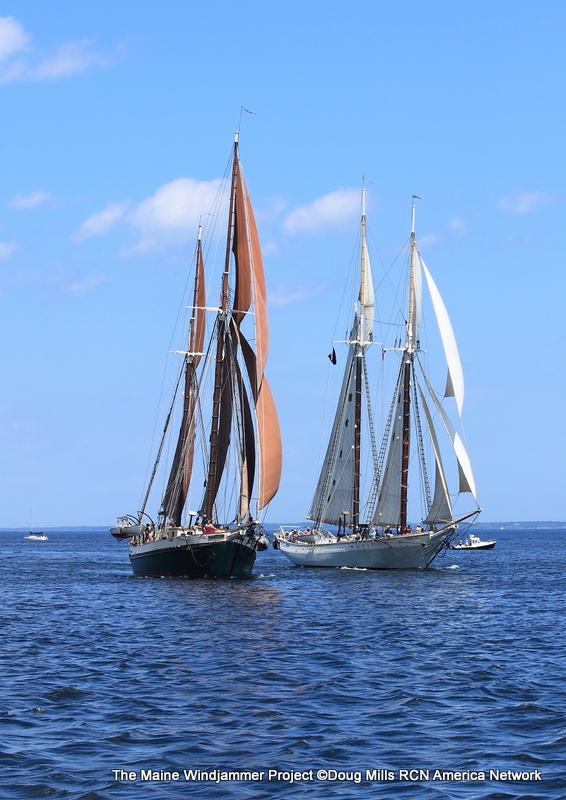
Angelique and Mary Day fly past the Rockland Breakwater Lighthouse

Doug Mills
Maritime Editor
RCN America Network

Penobscot Bay Maine-Last night seems like a dream. Standing on deck watching as the historic tall ships of the Maine windjammer fleet sail into the small harbor on Islesboro Island Maine.
Today is The Great Schooner Race. The Maine Windjammer Association has sponsored this race every year since 1977. I am very excited and head up on deck very early. The site that I find is nearly impossible for me to convey with words. The morning sun is just climbing over the horizon. The water is like a blue mirror. The air is still and cool. All around our anchorage are historic ships ranging in age from about 30 years to 143 years old with the new morning sun and perfect reflections in the cool blue water.
By 8AM the captains have started to arrive for the prerace meeting. The days race course is laid out and and the start times for the various classed of ship have been established. After a group shot of all the captains it is time for them to return to their individual ships and make ready for the start of the race.


The captains of the historic Maine windjammer fleet.
The Great Schooner Race is the largest annual gatherings of tall ships in north America and one of the only tall ship events in the world where passengers are onboard and encouraged to take part in the setting of the sails and the working of the ship. Some of these vessels in the past were used to haul stone, lumber and freight, others in the fishing trades. They were built to create income for their owners with an expected lifespan of 5-15 years. Today these proud ships are still working generating income for their owners, only now the cargo loads and unloads itself.

The race start.
At 10:20 the 10 minute warning canon fires amidst a flurry of clanging anchor chains and ships making ready to get underway. 10:25 the 5 minute warning sounds as all the boats move toward the start line. With the roar of the start canon the first boats move across the start line and The Great Schooner Race is underway! Before long Penobscot Bay is filled with the sails of schooners making their way upwind to Rockland. Today this is an amazing sight, but, 100 years ago this was just business as usual. So commonplace that the history books barely make mention of the schooner. It was nothing more than the tractor trailer of it's time delivering everything from lumber and granite to your great grandfathers new Sunday suit.

By mid afternoon we round the ledge and make for Rockland Breakwater Lighthouse with a stiff wind. The old Victory Chimes healed over in the wind and flying across the bay, the rest of the fleet in close pursuit. We reach the lighthouse along with most of the fleet to the cheers of the crowd of spectators who have gatherer to watch the end of the race. One after the other the ships fly into the harbor to make their turn around the marker in the middle of the harbor and head out again to the last mark and return like a flock of screaming eagles to the finish line at the Rockland Breakwater Lighthouse.

The final results are as follows:

Cutty Sark Award for overall winner:
Mary Day

Flying Jib Class:
Lazy Jack II (1st); Olad (2nd); Prudence (3rd)
Coasters Class:
Stephen Taber (1st); Grace Bailey (2nd); Lewis R. French (3rd)
Leeward Class:
Nathaniel Bowditch (1st); Angelique (2nd); Heritage (3rd)
Windward Class:
Mary Day (1st), American Eagle (2nd)
3-Masters Class:
Victory Chimes (1st!)
Frank Swift Award:
Isaac H. Evans
Boyd Guild Award:
J&E Riggin


The Great Schooner Race is over for this year and if you missed it you missed one of the most exciting events of the year. Not to worry, you can still experience the thrill of being on one of these ships next year and there is still room on many trips this summer.


For more information or to book your trip on one of these historic ships you can go to: http://sailmainecoast.com/ the Web site of the Maine Windjammer Association.

Maty Day overall winner!


Angelique


BEST OF 2013: Video Update: Tall Ship Timberwind Relaunch

After two weeks out of the water mid-season to repair a warn out rudder shaft the pilot schooner Timberwind was relaunched yesterday afternoon at the North End Shipyard in Rockland Maine.
For more information on this historic vessel or to book a week aboard the Timberwind you should visit: http://schoonertimberwind.com


Tuesday, December 31, 2013

BEST OF 2013: Video: Tall Ship Victory Chimes "Home To Rockland"

Doug Mills
Maine Windjammer Project
www.mainewindjammerproject.com

As long as I can remember I have watched the Victory Chimes sail into Rockland harbor.  Today I find myself at the Rockland Breakwater Lighthouse filming that same ship and feeling that same old thrill.
The Victory Chimes, built in 1900, has been sailing the cool blue waters of the Atlantic for 113 years!


BEST OF 2013: Video: 2013 Summer Solstice


Last night Rockland held it's Summer Solstice street fair.
The downtown restaurants, food specialty shops along with retail shops all participated with Food, Solstice Sidewalk Sales, and Entertainment and Activities.

Maine's "Official Treat" is featured in The Whoopie Pie Eating Contest.

Street Entertainment featuring local groups performed throughout the evening on the street.  Paul Benjamin, North Atlantic Blues Festival, brought back Summer Solstice favorite bands along Main Street with a wide variety of types of music and en exciting presentation from the Studio Red dancers.


It was clear from the crowds that everyone was having a great time.


BEST OF 2013: The Ultimate Tall Ship Photo Safari


Story and photos By
 Doug Mills
Maritime Editor
RCN America Network

Since I was a little boy I have dreamed of sailing on the Victory Chimes. I would watch her sail in and out of the harbor year after year and dream.
Never give up on your dreams! On July 4th 2011 the Victory Chimes sailed from Rockland, Maine to participate in the Great Schooner Race, the largest annual gathering of tall ships in North America. I  was on board, with my son,that week to host the ultimate tall ship photography cruise.
This this was our chance to see and photograph these tall ships put through their paces at the Great Schooner Race. We got to experience firsthand the romance of sailing these historic ships.

   This was not my first trip out on the “Big Boats”,but it would be my first full week sailing, my first time participating in The Great Schooner Race and my first time leading a photography workshop.
   We boarded the Victory chimes on Sunday after supper and spent the evening getting settled into our cabins and getting to know the rest of the passengers and crew.
Day 1
   We sailed after breakfast with a heavy fog on the bay.  Passing North Haven in the fog we turned up the bay toward Cape Rosier and Castine.  By noon the fog had been replaced by bright sun.  As we sailed into Castine harbor the afternoon sun became clouded by oncoming thunderheads.
   Through the late afternoon the fleet assembled in Smith’s Cove just east of Castine.  What a sight to see all this history anchored in one cove.  Many of these historic boats were over 100 years old!
   Lobster dinner and a spectacular sunset and it is time to turn in.

Day 2
   What an amazing sight, to come up on deck and find the water like glass with the last of the morning fog still clinging to the water and the morning sun bright overhead.
   Today is race day!  This morning all the captains meet on board the Victory Chimes to determine the final course for The Great Schooner Race of 2011.  After breakfast all the boats make sail and head out through Castine harbor toward the starting line.
   The race starts at 11;00 AM in spite of a lack of wind.  The wind did pick up by mid-afternoon with the Mary Day crossing the finish line first.
   The fleet anchored East of Stonington with fireworks and another great sunset to end the day.


Day 3
   After breakfast we sailed into Stonington Harbor in the morning fog.  What an amazing town.  Once a busy port shipping Maine granite all  over the world, now it is a busy fishing village.  The harbor is filled with colorful lobster boats and the shops were like stepping back in time to the 50’s.  Everywhere you turned there was another exciting picture!  By noon we were back on the boat and sailing east.
   Our destination for the night would be Wooden Boat Cove, a place that attracts sailors of wooden boats like honey attracts bears.  This little cove in Brooklin, Maine is the home of The Wooden Boat School and Wooden Boat Magazine.  This is a place that is very close to the heart of the sailing industry, a place almost sacred to those who sail these old wooden boats.
  Thunder showers at sunset set us up for some spectacular photographs to end the day.

BEST OF 2013: Camden Hills Regional High School Graduation Gallery

"If opportunity doesn't knock, build a door." CHRHS 2013 Class Moto

Camden Hills Regional High School graduated 159 on Friday.  With 15 Honor Graduates, 27 National Honor Society and 3 National Technical Honor Society graduates it is clear this is a class that will go far.